


The Nine Herb Charm
There’s a charm tucked inside a strange manuscript in the British Library. It is known as the Lacnunga manuscript, a compilation of various recipes and remedies dating back to 1000AD Anglo Saxon England. Its exact origins are uncertain, but the manuscript was compiled by at least two scribes who recorded a mixture of folk remedies and Christian healing practices in both Old English and Latin. Amongst its many curious entries, there’s one in particular, that caught my attention: the Nine Herb Charm.
I stumbled upon it while searching for a theme for my Herbology course’s physic garden project— I was immediately fascinated by the plants used in the charm, some of whose identity we’ll never know for certain. Within a few days, I was delving into Old English translations, trying to decipher which plants to cultivate in my little garden plot. Since then, the charm has taken me on quite the journey — from sowing its seeds and delving into its historical roots, to crafting a cream inspired by its words.
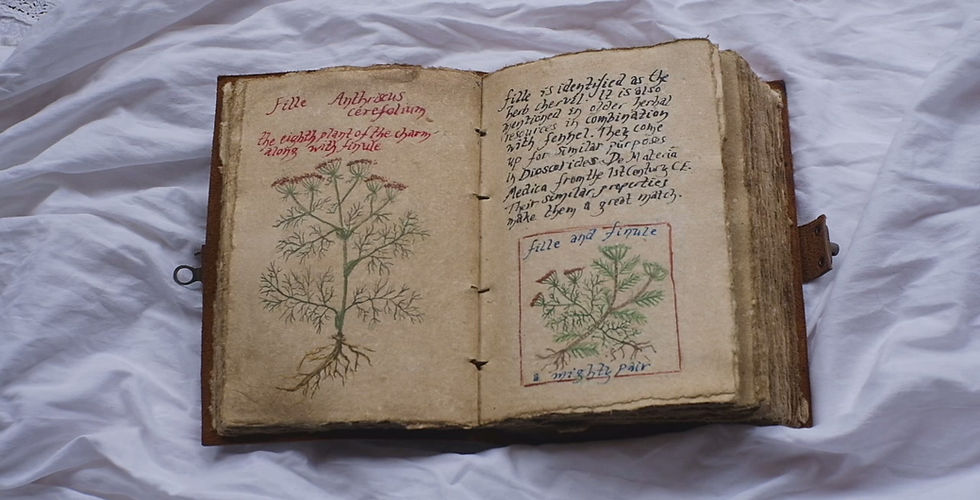
As part of the Royal Botanic Garden's Edinburgh (RBGE) Herbology Diploma (2025/26) I focussed on reconstructing and reinterpreting the Nine Herb Charm and other adjacent historical herbal remedies found in the Lacnunga manuscript. By growing mugwort (Artemisia vulgaris), nettle (Urtica dioica), ribwort plantain (Plantago lanceolata), wood betony (Betonica officinalis), chamomile (Chamaemelum nobile), hairy bittercress (Cardamine hirsuta), crab apple (Malus sylvestris), chervil (Anthriscus cerefolium) and fennel (Foeniculum vulgare), I was able to study each plant’s development and qualities over time.
Alongside cultivating the plants, I documented the journey and background of the Nine Herb Charm through a manuscript recreation. I wrote about the experience of growing the herbs as well as painting them in a manuscript. This immersive approach allowed me to connect historical knowledge with contemporary observation, creating a visual and material dialogue between past and present.

Snippets of the plot
The manuscript was on display as part of the Herbology exhibition at the the Royal Botanic Gardens Edinburgh (RBGE) between 3th February and 28th June 2026. The exhibition celebrated 20 years of their Herbology course and the enduring healing and cultural power of plants.

“I alone know of a river running
where the nine adders keep watch”
— Snippet of the nine herb charm, Lacnunga manuscript, 10th century
It’s funny to me, in a way, that this magical charm, likely passed down through generations by word of mouth, ended up preserved in such a patchwork, slightly chaotic manuscript. A jumble of remedies and incantations, the Lacnunga is certainly not a polished archive and I love that.
I can spend hours poring over interpretations in papers and books, but in the end, my intuition reminds me that this charm is just a small fragment of a much larger history — one we’re lucky to have at all. While research can reveal so much, it’s the act of reawakening the charm, of working with it directly and intuitively, that brings its enchantment fully to life.


